Forex trading for beginners starts with a demo account, market structure basics and strict risk limits before any real money
Want articles like this for your own video to promote it on YouTube and Google? Order them through the Telegram bot @sat_sit_bot. Articles with your video embedded are written and posted by the bot itself — on popular topical sites (no ads). Try it free: 50 articles on us.
· based on the channel Carl Fx
Key takeaways
- Forex is an over-the-counter market where currencies are quoted in pairs such as EUR/USD, and retail traders usually access it through a broker rather than an exchange.
- A demo account costs nothing and should be used until a beginner can execute the same setup repeatedly with a written plan.
- Market structure means reading higher highs and higher lows in an uptrend versus lower highs and lower lows in a downtrend before looking for entries.
- Risk per trade should be a fixed small percentage of the account, with the stop loss placed by structure, not by hope.
- Most beginner losses come from oversized positions, no stop loss and revenge trading after a losing streak.
Forex is the market where national currencies are traded against each other in pairs, and a beginner starts by learning how the market works, opening a broker account and practising a single simple strategy on a demo before risking real money. The practical route is: understand the mechanics, study market structure and price action, define entry and exit rules, then size every position so one loss cannot damage the account. Carl Fx, who runs the channel behind the guide this article is built around, points new traders to registration at TFC Global Markets as the broker he uses and owns.
What forex trading actually is and who is on the other side
Forex is a decentralised over-the-counter market where banks, funds, companies and retail brokers trade currency pairs around the clock during the trading week. There is no single exchange like a stock market; prices come from a network of liquidity providers, and a retail broker passes your orders into that network or takes the other side of them. The most traded pair is EUR/USD, followed by USD/JPY and GBP/USD, and these majors usually carry the tightest spreads. Currencies are quoted in pairs because every trade is simultaneously a purchase of one currency and a sale of another, so a long EUR/USD is a bet that the euro strengthens against the dollar. Prices move on interest-rate decisions, inflation data, employment reports and risk sentiment, which is why the calendar matters as much as the chart. Leverage is what makes forex attractive and dangerous at the same time: a broker may offer 1:100 or more, meaning a small deposit controls a much larger position, and losses scale with the position size rather than the deposit.
How to open a trading account and what to check before funding it
Opening an account takes minutes, but the checks around it decide whether the experience is safe. A beginner should compare regulation, spreads, execution and withdrawal terms before depositing anything.
- Choose a broker and verify which regulator supervises it; segregated client funds and a clear withdrawal policy matter more than a welcome bonus.
- Register with an email and password, then complete identity verification with an ID document and proof of address, which is a legal requirement for regulated brokers.
- Open a demo account first and trade the same strategy there for several weeks.
- Fund a live account only with money that can be lost without affecting your life, and start with the smallest position sizes the platform allows.
- Install a trading platform such as MetaTrader 4, MetaTrader 5 or cTrader, learn where the stop loss, take profit and lot size fields are, and test order execution on demo.
Carl Fx links account opening at TFC Global Markets through this registration page and discloses that he owns the brokerage, which is worth knowing when weighing any recommendation. He also runs a free Telegram community at https://t.me/carlsmcforex where beginners compare charts and questions.
Reading bullish and bearish markets through market structure
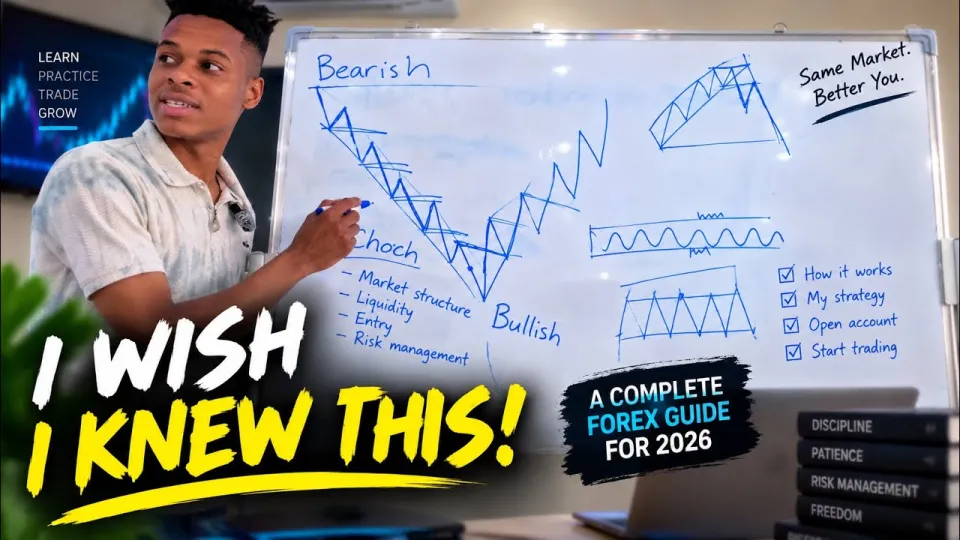
Market structure is the skeleton of price action: it describes whether buyers or sellers are in control by tracking swing highs and swing lows. In a bullish market, price prints higher highs and higher lows; in a bearish market, it prints lower highs and lower lows. A trend continues until structure breaks, and that break is the first objective signal a beginner can read without indicators. Practically, a trader marks the most recent swing high and swing low on a higher timeframe such as the four-hour or daily chart, then drops to a lower timeframe only to refine entries. Ranges are the third state: price oscillates between a ceiling and a floor, and breakout attempts fail until one side gives way. Candlestick behaviour supports the reading — long wicks rejecting a level, strong closes through a prior swing, or a failed push beyond a high all tell you who is being trapped. Learning this one skill replaces a screen full of indicators, and it is the part of the guide that Carl Fx frames as the foundation he wishes he had at the start.
A simple price-action strategy a beginner can practise
The strategy is a structure-based pullback: wait for a clear trend, wait for price to return to a level, then enter in the direction of the trend with a stop beyond the level that invalidated the idea. A workable version looks like this.
- Identify the trend on the higher timeframe using swing highs and lows.
- Mark the zone where the last impulsive move began, such as a broken swing high that should now act as support in an uptrend.
- Wait for price to reach that zone and show a rejection candle or a lower-timeframe structure shift in your favour.
- Place the stop loss just beyond the zone, set a target at the next swing high or at a multiple of the risk, and calculate the lot size from that distance.
- Risk a fixed small percentage of the account, commonly 0.5% to 1% per trade, so a losing streak is survivable.
- Journal every trade with a screenshot, the reason for entry and the result, then review the journal weekly.
One setup traded fifty times teaches more than ten setups traded five times each, because the sample shows whether the edge is real. Beginners who ask for chart examples are asking the right question: the skill lives in repetition on live charts, not in memorising rules.
Mistakes that cost beginners money and how to avoid them
Most beginner accounts are lost to a short list of avoidable errors rather than to a bad strategy. Oversized positions turn a normal losing trade into an account-ending event, so position size should be calculated from the stop distance every single time. Trading without a stop loss, or moving the stop further away to avoid being wrong, converts a small planned loss into an uncontrolled one. Revenge trading after a loss, and increasing size to win it back, is the fastest route from a drawdown to a blown account. Overtrading during quiet sessions, chasing a candle that has already moved, and switching strategies after two losses all destroy consistency. Skipping the demo phase and funding an account on day one removes the cheapest learning environment available. Finally, treating forex as a shortcut to quick income rather than a skill built over months is the assumption behind most of the disappointment voiced by new traders.
Questions beginners ask before their first trade
A recurring worry is access: some people struggle to open a live account because of verification documents, local payment methods or minimum deposits, and the fix is to ask the broker's support directly and stay on demo until the account is approved. Another common doubt is comprehension — the feeling of not grasping the material — which usually means the learner is consuming too many sources at once; one timeframe, one setup and a written checklist solve it. Others want to know how long the demo phase should last: the honest answer is until the results are consistent over at least a few dozen trades, not until a fixed number of days passes. And the question of capital comes up constantly, because a small account feels limiting; the response is that small size is an advantage while learning, since the cost of mistakes is proportionally lower and the habits formed are the same ones that scale later.
Useful links
- Account registration at TFC Global Markets: https://www.tfcglobalmarkets.com/sign-up?ref=CARLFX
- Free Telegram community run by Carl Fx: https://t.me/carlsmcforex
The realistic path from first chart to first funded account
Forex rewards process over prediction, and the sequence that works is unglamorous: learn the mechanics, read market structure, drill one setup on demo, size every trade from a fixed risk limit and review the journal. The guide from Carl Fx on the Carl Fx channel follows that same order — how the market works, how to open an account, bullish and bearish structure, a simple strategy and the mistakes to avoid — and it is a sensible starting point precisely because it does not promise overnight profits. Anyone ready to take the next step can begin with registration at TFC Global Markets, the broker linked in the video, keeping in mind that the channel owner discloses ownership of it. Trading involves significant risk and profits are never guaranteed, so demo first, small size second, and real money only when the process is already boring.
Questions & answers
How much money do I need to start forex trading?
There is no universal minimum, and many brokers accept small deposits, but the amount matters less than the risk per trade. Starting with a modest sum and risking 0.5% to 1% per position keeps early mistakes affordable while the process is being learned.
How long should I stay on a demo account before going live?
Stay on demo until the same setup has been executed consistently over several dozen trades with a written plan and a journal. A fixed number of days is a weaker test than a stable sample of results.
Why can it be hard to open a real account?
Regulated brokers require identity verification, and local payment methods or minimum deposits can add friction. Contacting broker support directly and remaining on demo until approval resolves most of these issues.
Is forex trading a realistic way to make quick money?
No. Forex is a skill built over months of practice, and leverage magnifies losses as easily as gains. Treating it as a long-term discipline with strict risk control is the only sustainable approach.
Source: How To Start Forex Trading For Beginners in 2026 (Full Guide + My Strategy) · Markdown version